

Creating in a world that forgives nothing
On Camus' Create Dangerously...
Camus is inescapable in the literary and philosophy world. A French-Algerian writer, philosopher and journalist who is often grouped with the existentialists — although he would reject that label.
He is best known for the idea of the absurd, which was explored predominantly in The Myth of Sisyphus. This is a work in conversation with the likes of Jean-Paul Sartre and Søren Kierkegaard. Here Camus is refusing to seek solace in either faith or reason, but instead is advocating for an acceptance of life’s lack of ultimate meaning without retreating into despair or false hope.
In terms of fiction, there is also The Stranger, where a detached narrator, Meursault, commits a seemingly senseless act of violence. The novel explores alienation, morality, and society’s need to impose meaning.
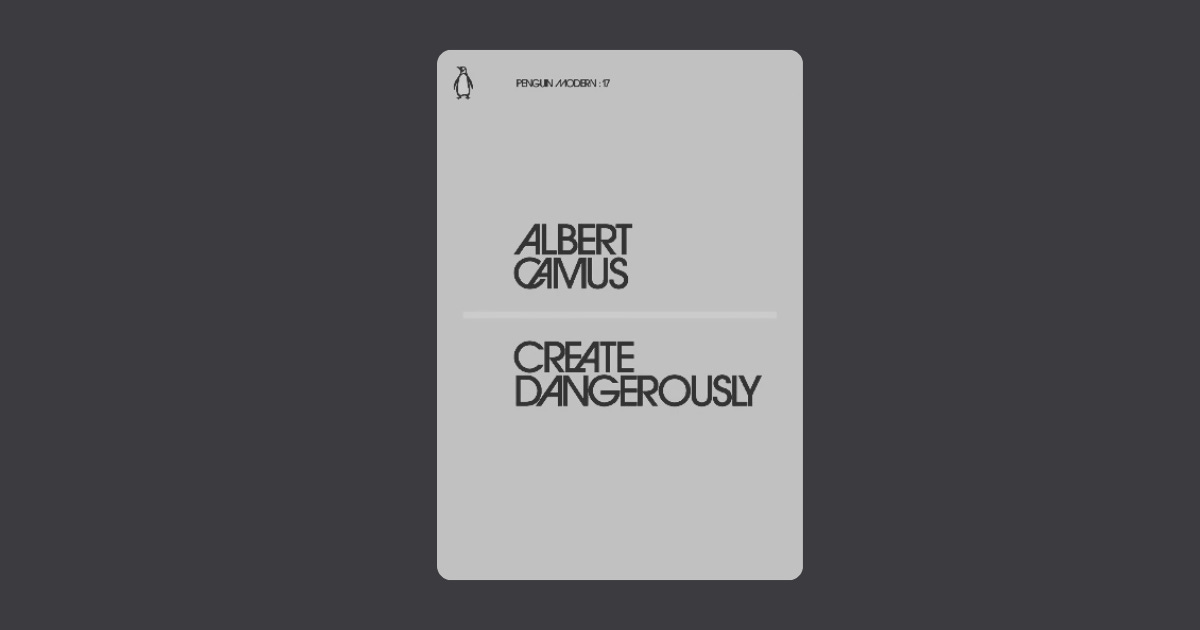
But it is not these momentous works that I want to focus on today, but instead a short lecture Camus delivered in 1957. Now titled Create Dangerously and published by Penguin in one of those little mint-coloured books, this lecture was originally titled The Artist and His Time.
Given the date, Camus was speaking at the height of Cold War ideological tensions and not all that long after World War II. He was aiming to define the ethical responsibilities of artists in a fractured world. How can an artist create freely in a world shaped by violence, ideology and censorship? What was the direction of the novel now?
I recently read Camus’ piece and want to chronologically work through some lines that I underlined, to unpack what Camus is saying and what contemporary relevance this may hold — especially in a time where there is a lot of turmoil.
“If they speak up, they are criticised and attacked. If they become modest and keep silent, they are vociferously blamed for their silence.”
I thought the speaking up/silence epidemic,of not being able to diverge from mass opinion, was a recent phenomenon, but it seems not. Internet culture has only exaggerated this impact.
There is no way for an artist to win in a politicised world. Camus is describing a double bind where if the artist speaks out they are attacked for their biases or preferences. On the other hand, if they are silent they are seen as cowardly or complicit. Judgement looms over them either way.
There becomes no possibility of there ever being “safe” art. This is not necessarily a critique of the artist, but instead a critique of society. The public is demanding contradictory things, and what this contradiction reveals is that a culture has developed that does not actually want truth but instead a confirmation of its own beliefs.
This comes in the context of a post-war world where artists were expected to be morally legible at all times, but this ethical exposure is even more blatant in contemporary culture.
“To create today is to create dangerously. Any publication is an act, and that act exposes one to the passions of an age that forgives nothing.”
This line is where the current title of the lecture arrives from. Flowing on from above, Camus is saying that to create is no longer purely aesthetic — it becomes situational.
The artist has to engage with the tensions between truth and propaganda, as well as individual voice and collective pressure.
To create dangerously is not metaphorical, it is literal. Each word an artist writes puts them at risk. One example is Salman Rushdie, who was stabbed in 2022 as a consequence of words he had previously delivered. Danger is not metaphorical — it is social and political.
To write, and to publish, is an action that you decide upon. You are not saying, you are doing. And responsibility has to be taken; it is what determines the artist’s fate.
“In the face of so much suffering, if art insists on being a luxury, it will also be a lie.”
